Freelancer licence and visa in the UAE: setup and support
A commercial licence for one person: the right to work for yourself in the UAE, invoice clients, and get a residence visa with a 2-year Emirates ID. No office, no staff.
- IT and development
- design
- media and content
That is roughly ten working days. Book your return flight with room to spare, or book it once you are there.
That visa is for people employed by a foreign company, and it does not allow you to take clients inside the UAE. This one is the opposite.
Tax calculator for the UAEOpen it and see what you keep after tax
The regime being compared is «UAE corporate tax (0% / 9%)». Enter your own net profit and the rate you pay today — whichever it is. Profit after expenses, not turnover: that is what corporate tax is charged on.
An indicative calculation from the figures you entered — it does not account for deductions, double taxation treaties or the specifics of your current jurisdiction. The exact calculation comes on the free consultation.
What a UAE freelancer licence gives you
A freelance licence (also called a freelance permit) is issued to one person. On it you sign contracts, invoice and take payment — from individuals and from companies inside the UAE alike. There is no employer and no employment contract, and you are not considered an employee of the client.
The licence is the basis for a residence visa and a 2-year Emirates ID. With them come a personal UAE bank account and the right to sponsor a spouse and children.
No company is registered along the way: no articles, no share capital, no shareholders and no annual audit.
The terms the expert works on
Guarantees the outcome by contract
Writes the outcome and the timeline for every service — including opening a bank account — into the contract, and answers for them.
Bills in stages
You do not pay the whole sum up front: invoices come in instalments as each stage closes.
Fixes the price in the contract
The cost is locked in and does not grow as the work goes on. Prices on the site are indicative — the final figure comes after your case is reviewed.
Charges no hidden fees
No penalties or surcharges beyond the contract. No Pactors markup either: you pay the expert their own price.
Works with lawyers of 8+ years in UAE law
The licence for your activity is matched, and the requirements worked through, by qualified lawyers.
Thinks a step ahead
Picks the zone and the licence so that a year from now you do not hit a limit and have to redo the whole thing.
Deals with authorities directly
Handles government bodies, free zones and UAE banks personally — no chain of subcontractors.
Company formation in the UAE: comparing the options
The difference is not the price — it is who each option suits. The “Best for” column is the business profile the option is built around.
| Option | Best for | Timeline | Price |
|---|---|---|---|
| AFZA free zone (Ajman) | Trade, warehousing and the port, automotive, food, jewellery | ~1 week | from $1,550 |
| SHAMS free zone (Sharjah) | Media, content and creative, digital, unlimited visas | ~1 week | from $1,575 |
| RAKEZ free zone (Ras Al Khaimah) | Manufacturing, warehousing and logistics, e-commerce, startups | ~1 week | from $1,650 |
| Meydan free zone (Dubai) | Consulting, IT and digital, trading, media, any activity | ~1 week | from $3,500 |
| IFZA free zone (Dubai) | IT and digital, consulting, services, a first company in the UAE | ~1 week | from $3,500 |
| Freelancer licenceyou are here | IT and development, design, media and content, marketing, consulting | ~6 weeks | from $4,500 |
| Mainland (Dubai) | B2C in the UAE, government contracts, retail and food service, import/export | 1–2 weeks | from $5,890 |
| DMCC free zone (Dubai) | Precious metals and stones, commodities and energy, digital assets, trading | 1–2 weeks | from $9,400 |
Limits of a freelancer licence
The licence is issued to one person rather than to a company — that is where every limit comes from.
- You cannot hire staff — the work has to be done by you personally
- One licence covers one profession; a second one means a second licence
- It is not a substitute for a company: no legal entity, no shares, no business to sell
- Retail and anything with a physical presence is Mainland territory, not freelance
Who a freelancer licence suits: professions and activities
There are well over a hundred activities to choose from. The profession on the licence has to match what you actually do: it is evidenced by a portfolio, a CV or a website.
IT and data
- Web, mobile and desktop development
- Software architecture
- IT infrastructure and networking
- Data science and analytics
- Web design
Media and creative
- Photography, video, editing, sound
- Copywriting, journalism, translation
- Graphic design and illustration
- Social media, PR, marketing, brand consulting
- Producing and event planning
Design and education
- Interiors and object design
- Fashion, styling, jewellery design
- Make-up and hair styling
- Teaching and coaching
- Research and training
This is not the full list. We will match the exact wording to your profession on the consultation — it decides which zone fits and what the licence costs.
UAE visa photo requirements
The photo requirements are set by the UAE Federal Authority for Identity and Citizenship (ICP). Anything off-spec is grounds to send the application back and push the timeline.
No printing needed: the photo is submitted digitally and must be no more than six months old. A phone snapshot rarely passes — sharpness, even lighting and a flat background take ten minutes in a photo studio.
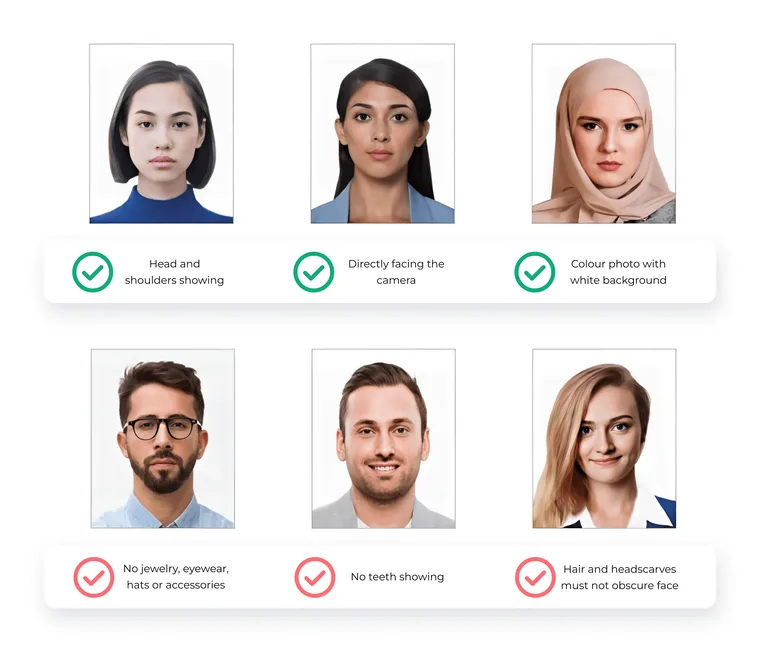
Required
- A colour photo 35–40 mm wide, with your face taking up 70–80% of the frame
- Head and the top of your shoulders, centred
- A plain light background — white is the safest choice
- Even lighting: no shadows on the face, no flash reflections
- Looking straight at the camera, both edges of your face visible
- Eyes open, no hair falling across them
- A neutral expression with your mouth closed
- Sharp focus and natural skin tones
- You alone in the frame
Not allowed
- Smiling with your mouth open and teeth showing
- Tinted lenses, glare on glasses, heavy frames covering the eyes
- Head coverings — for religious reasons only, and your face from chin to forehead must stay uncovered
- Turning to one side or tilting your head
- A busy background, or clothing the same colour as the background
- Other people or objects in the frame
- Blur, red eye, visible retouching
- Earrings and visible jewellery — not formally banned, but you will be asked to remove them
Freelance licence or remote work visa
The difference is not the price — it is where the money comes from. The remote work visa is for people whose income already exists abroad; working with clients inside the UAE is not allowed on it. A freelance licence permits you to carry on an activity in the UAE itself.
Freelance licence
This option- No income threshold
- Any clients, including companies and people inside the UAE
- You evidence your profession: portfolio, CV, website
- A 2-year residence visa
- Based on your own activity in the UAE
Remote work visa
- Proven income of at least $3,500 a month from abroad
- Clients and employer outside the UAE only
- You evidence income: contract and bank statement
- A 1-year visa, renewable
- Based on working for a foreign client
Renewing a UAE freelancer visa
File about a month before expiry. Renewal means another medical test and an updated Emirates ID; the zone may ask for contracts or invoices as evidence of activity.
A residence visa lapses if you stay outside the UAE for more than 180 days in a row. Golden, Green and Blue visa holders are exempt: they may enter at any time while the visa is valid. For everyone else ICP issues an entry permit, but not in advance — the application is filed from outside the UAE and only after 180 days away. Entry must follow within 30 days of approval, and the fee is AED 100 ≈ $27 for every month beyond the first six. The ICP service does not cover residents of the Emirate of Dubai. If residency is a status and you live elsewhere, plan on entering the country once every six months.
What the service includes
| A professional freelancer licence for your chosen activity | |
| Registration with the immigration authority | |
| Entry permit | |
| A 2-year residence visa and Emirates ID | |
| Support with opening a personal bank account | |
| Medical insurance — mandatory for the visa— billed separately | |
| Monthly bookkeeping— billed separately | |
| Visas for family members— billed separately |
Documents and programme requirements
- 1A passport valid for at least six months
- 2A photo meeting the ICP specification — see the breakdown below
- 3Proof of address: a document from any country will do — a registration stamp in your passport, a bank statement showing your address, a utility bill
- 4A portfolio, CV or website evidencing your experience in the chosen profession
- 5A trip to the UAE for the medical test and biometrics
How the process runs
~6 weeks- Before day 1Preparing and checking documents: passport, photo, proof of address, portfolio. The days on the scale below are working days and approximate: the timing depends on how fast the authorities move.
- Day 1The licence application is filed. Remotely — no personal presence required.
- Day 10Registration with the immigration authority — without it there is no residence visa. Remotely, 3–5 working days.
- Day 13Entry permit. A mandatory stage wherever you currently are. Remotely, 3–5 working days.
- Day 16You fly to the UAE for the medical test and fingerprinting. Up to 10 working days, in person. From this point until the visa is issued you cannot leave the country.
- Day 26The residence visa is issued — you are free to leave the UAE again.
- Day 30Emirates ID in hand. Issued remotely in 7–10 working days; you do not need to come back for it.
Frequently asked questions
Do I need an office for a freelancer licence?
Can I hire staff?
Who you can work with: clients in the UAE and abroad
Can I list several professions on one licence?
Do I have to file reports?
Is medical insurance required?
Can I bring my family?
What extra documents might be requested?
How long does the whole thing take?
Is corporate tax really 0% in a free zone?
Can a free zone company sell inside the UAE?
Can the activity be changed after the licence is issued?
Is bookkeeping and reporting mandatory?
What happens if the licence is not renewed?
Sources
- u.ae — the official UAE government portal: freelance work permit and self-employed status
- icp.gov.ae — personal photo specification, Federal Authority for Identity and Citizenship (PDF)
- u.ae — general provisions for the residence visa: absence from the country beyond six months
- icp.gov.ae — permit to stay outside the UAE for more than six months
- investindubai.gov.ae — remote work visa: the $3,500 monthly income condition
- tax.gov.ae — UAE Federal Tax Authority bulletin “Free Zone Persons”: conditions for the 0% rate
- rakez.com — official FAQ: trading inside the UAE, capital, documents
- dmcc.ae — Company Setup FAQs: capital, office, signing documents
Related breakdowns
A UAE visa for freelancers: Golden or Green in 2026
There is no Golden Visa category for freelancers. The real route is the 5-year Green Visa: a MOHRE permit, a degree and AED 360,000 income for two years.
Abu Dhabi licences 2026: what a foreigner can get
The Mobdea licence in Abu Dhabi is open to Emirati women only and Tajer runs through a partner. Here is what a foreigner can actually get, and the fees.
Opening a company in Dubai in 2026: steps and prices
A licence in 5 minutes for AED 1,370, the Invest in Dubai single window and what the Unified Licence really is. The real steps and the ones needing a trip.
We'll check your case before you pay
Send an enquiry — we will check your case and help you arrange “Freelancer licence and visa in the UAE: setup and support” in UAE. No markup on top.
We'll cover: whether you qualify, the full cost with fees, realistic timelines, the document list. If it's not for you, we'll say so.